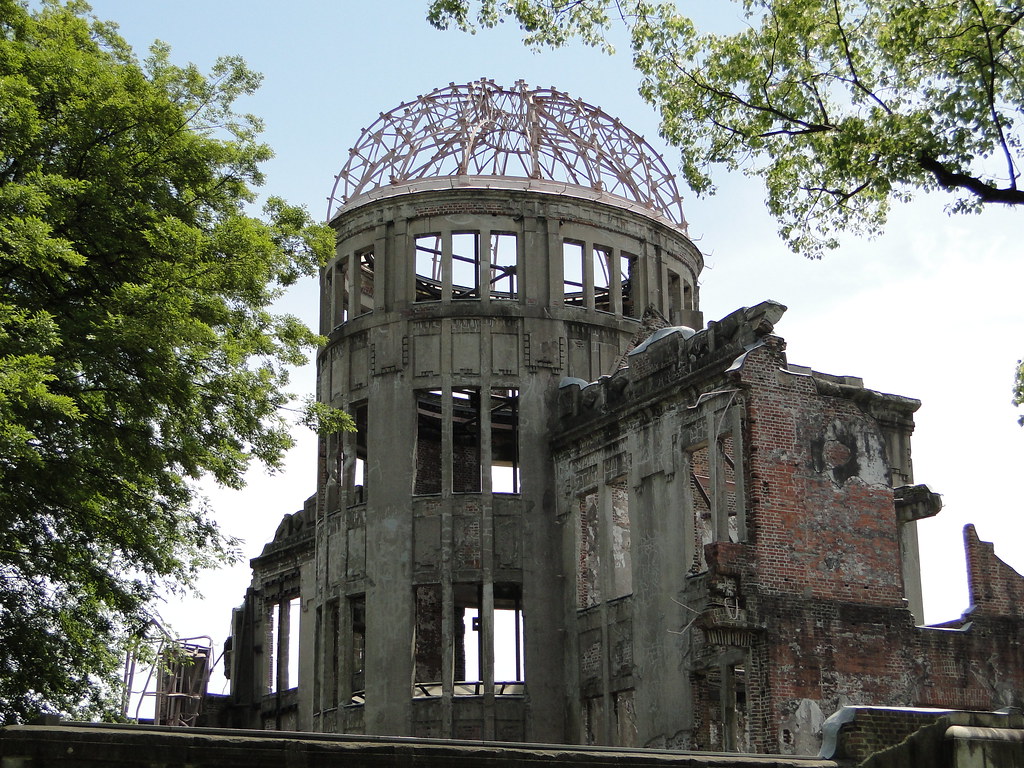
When I was growing up it was commonly understood that the atomic bombing of Hiroshima and Nagasaki ended World War II. It was equally accepted that, as horrible as the aftermath of those attacks were, the events themselves were a good thing. Those who lived through the war years saw nothing wrong with using whatever weapons were at hand to defeat a terrifying enemy.
Today, that opinion has been subverted.
Today we are told that the bombs were not necessary, that Japan was trying to surrender, that America was a racist nation who would not have used the bombs against Germany, Italy, or any other “white” nation. We are told that America is a bully that beats up on weaker, non-white populations.
Those concepts are worthy of discussion, and here and there a grain of truth may even emerge. It is true that one segment of the Japanese government was seeking an avenue of surrender; it is equally true that the military establishment that held Japan firmly by the throat (and had the real power) would never have accepted any such thing. It is also true that most Americans of that period viewed the Japanese as something less than human.
But that doesn’t change the fact that the bombs were necessary.
A Step in Their Shoes
In an era where Americans are daily dipped in the brainwash of gun control and pacifism, it’s easy to look back 64 years and pass judgment on our parents’ generation. But not one of us has ever walked in their shoes. We have never experienced the fear — no, the terror — of imminent invasion, which seemed likely in the days immediately following Pearl Harbor. Today we have satellite communications, the internet, instant access to the entire world. We know the Japanese, understand their culture, and their history. None of that was true in 1941, and by 1945, what Americans did know about the Japanese was that they were a dangerous, desperate enemy who must be defeated at all costs.
By 1945, Americans were beginning to learn about the Japanese occupation of China and Southeast Asia, about the atrocities, the brutality, and the inhumane treatment of prisoners of war. Americans had learned about the Bataan Death March, and they still had only glimpsed the tip of the iceberg. Japan had to be defeated.
Right or wrong, the atomic bombs convinced Japan to stop fighting. The war ended mere days after their use.
But, morally speaking, was it right? Or was it wrong? That debate will probably never end, but we can put it into some perspective. There is no question that, had they possessed such a weapon, the Japanese would have used it, especially when their military reverses left them reeling on the defensive. But that fact alone doesn’t make it right.
Today’s pseudo moralists will argue that it was a terrible loss of civilian life, when a single bomb could kill 80,000 people. Yet there was already precedent for such an event — major cities in Europe and Japan had been fire-bombed with conventional weapons, resulting in huge death tolls — Hamburg (40,000), Dresden (40,000), Tokyo (100,000); Kobe, Osaka, and others. By contrast, Hiroshima’s death toll is estimated at 80,000, and Nagasaki at 39,000.
The major difference, of course, was the after-effects of the bombing. Tens of thousands more died from radiation, many of them decades after the event. This particular horror sets the atomic bombings apart from other similar events.
What happened in Hiroshima and Nagasaki, right or wrong, is too horrible to contemplate. No one who did not experience it can possibly grasp the absolute horror, the incomprehensible personal tragedy that descended upon those cities. No book, no movie, no documentary can adequately present what happened there.
But, horrible as it was, I believe there is a positive result of those attacks.
The Cold War
Think back, if you’re old enough, to the Cold War, those years that followed World War II and ended around 1989. Do you remember the daily threat of nuclear holocaust? It wasn’t something you dwelt on, because if you let yourself think about it you would be paralyzed with terror. You simply could not function. But it was there, always, in the back of your mind, hanging over your head. Absolute devastation. The weapons, we were told, were each more than 1000 times more powerful than the “firecrackers” that devastated Japan. The blast wave from a thermonuclear bomb might spread 20 miles or more, and buildings 50 miles from ground zero would be set ablaze. Nothing was likely to survive.
Both the United States and the Soviet Union stockpiled those weapons by the thousands, when only a few dozen were enough to wipe out the world. The escalation seemed hopeless, and everyone wondered if there was any possibility that it might not happen. Sooner or later there would be something, an accident, or a madman, and the world would be incinerated.
It didn’t happen.
Why not?
Hiroshima Saved the World
Before August 6, 1945, no one really knew what an atomic weapon could do. Scientists had their theories, but no one knew for sure. Shortly after the war ended the world found out. The results were far more horrible than even the scientists had feared. Humanity reeled in shock at film taken in the stricken cities. Atomic weapons were truly Satanic in nature.
I believe that, during the Cold War, it was this knowledge that saved the world from total destruction. No matter how militaristic or power hungry either of the belligerents became, no one was quite willing to pull the trigger that would start a nuclear war. Why? Because even if you got off the first shot, you knew that retaliation was automatic, and your own cities would be burned to a cinder within an hour of the first attack. And you had seen the pictures from Japan…you knew what those weapons could do.
There could be no “winner” of such a war.
What happened to the people of Hiroshima and Nagasaki was a tragedy without equal, a terrible sacrifice of human life. But if those bombs had not fallen, and that sacrifice had not taken place, in the years that followed it is very likely that the entire world would have perished.
If such weapons fall into the hands of religious fanatics…it still might.
–March 26, 2009
 Private Thoughts